
How to Turn Website Content into Cold Outreach Email Scripts
Most cold outreach fails before it's even read. The subject line looks generic, the opening doesn't connect to anything real, and the pitch could have been sent to anyone. The recipient senses this immediately — and moves on.
The fix isn't a better template. It's a better source. Your website already contains everything a strong outreach script needs:
- the problem you solve,
- the way you talk about it,
- the proof that you deliver,
- the tone your brand carries.
The gap is knowing how to extract that material and shape it into something a stranger will actually respond to.
This article walks through a practical framework for doing exactly that — from identifying what on your site is worth mining, to turning those raw materials into email scripts that feel personal without requiring you to write from scratch every time.
Jump to a Section

Why cold outreach fails
The core problem with most cold emails isn't the channel — it's that the message has no anchor. It references nothing specific about the sender's business, nothing specific about the recipient's situation, and nothing that distinguishes the offer from a dozen similar ones.
There's a structural reason this happens. Most outreach is written in isolation, disconnected from the brand's actual positioning. The result is messaging that sounds like it was assembled from parts: a generic hook, a vague value claim, a weak CTA. The person reading it can feel the distance between the sender and the words on the screen.
Personalization patches help — adding a first name, referencing a LinkedIn post, mentioning a recent company announcement. But personalization layered onto generic positioning still produces generic outreach. The problem runs deeper than the opener.
What actually works is specificity — and specificity comes from having source material. The businesses that get replies from cold email aren't necessarily better at persuasion. They're better at translating what they already know about themselves into language that lands for someone else. That translation requires a starting point. For most small businesses, the starting point is already sitting on their website, largely unused for this purpose.
There's one more failure mode worth naming: volume as a substitute for quality. Sending 500 undifferentiated emails is not a strategy — it's a way of avoiding the harder work of figuring out what you actually want to say. The businesses that treat outreach as a numbers game tend to get number-shaped results: low reply rates, lower conversion, and a growing suspicion that cold email doesn't work. It works. But it requires a message worth sending.
Your website as an outreach source
A business website, when it's working properly, already does the core persuasion job: it explains what you do, who it's for, why it matters, and why you specifically. That's the same structure a good cold email needs. The difference is context and length. Here is the core logic behind using website copy for cold prospecting: the persuasion architecture is already there.
Here's what's worth pulling from your site — and why each element earns its place in outreach:
- the mission or "why" statement, usually on an About page, tells you what problem the business genuinely cares about solving — not just what service it offers. That distinction matters in email.
- testimonials and case studies give you third-party proof in concrete terms. A line like "cut admin time significantly for a three-person team" is far more credible than any claim you make about yourself.
- the unique selling proposition — the thing your homepage leads with — is often already written in prospect-facing language. It just needs to be trimmed and reoriented toward a single reader.
- tone and voice cues from your copy tell you how formal or informal the email should feel. A brand that writes warmly on its site shouldn't send stiff outreach — the inconsistency signals inauthenticity.
One thing to watch for: website copy is often written for someone already curious about you. Outreach copy has to earn that curiosity first. So the translation isn't copy-paste — it's compression and reorientation.
It's also worth thinking about which pages on your site are doing the most persuasive work. For most small businesses, the homepage carries the positioning, the services or product page carries the logic, and the About page carries the trust. Outreach emails typically need all three — a hook from the positioning, a line from the logic, and a proof point from the trust layer. Mapping your site that way before you start extracting makes the process faster and the output more coherent.

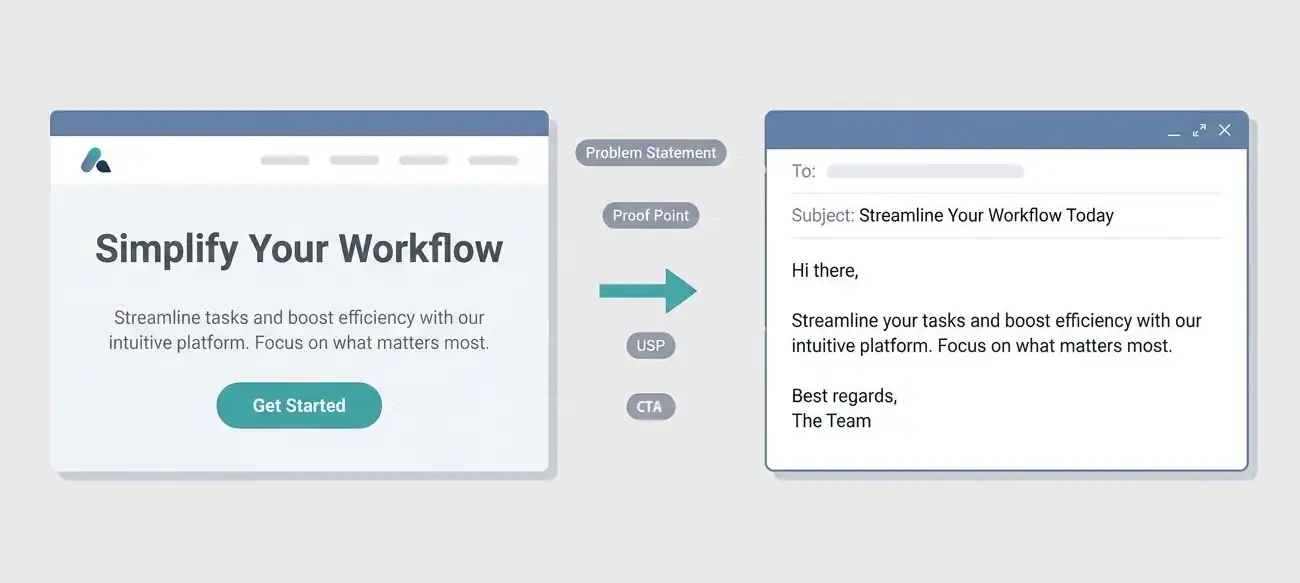
Website → email framework
The framework below works as a repeatable process. Run your site through each step before writing a single line of outreach.
Step 1 — Extract the core problem statement
Find the sentence on your site that names the problem your service solves. Not the feature, not the outcome — the problem. If your site says "We help retailers manage inventory across multiple locations," the problem statement is: multi-location inventory is hard to manage reliably. That's your email's opening anchor.
The problem statement works best when it's written from the prospect's perspective, not the seller's. "Managing stock across locations is a daily source of error" lands differently than "We solve inventory problems." Same idea, very different effect.
Step 2 — Pull one proof point
From your testimonials, case studies, or results section, find one concrete example. It should have at least one specific detail — a number, a timeframe, a business type. Vague proof ("our clients see great results") adds nothing. Specific proof ("a regional distributor reduced order errors after six weeks") earns attention.
If your site doesn't yet have proof points in this form, that's a signal. Collecting one or two concrete client results — even informal, even approximate — and putting them on your site pays dividends far beyond outreach.
Step 3 — Distill your USP into one sentence
Your homepage probably leads with your differentiator. Condense it to a single sentence that answers: why you, not someone else? This is harder than it sounds. If the answer is "we're experienced and reliable," keep going — that's not a USP, it's a baseline expectation.
A useful test: swap your company name for a competitor's and read the sentence again. If it still holds, you haven't found your USP yet. Keep narrowing until the sentence only works for you.
Step 4 — Match the CTA to your site's conversion logic
Whatever action your site is optimized for — a consultation call, a demo, a proposal — that same action should close your email. Asking for something different creates friction. If your site converts on "book a free audit," your email should end with exactly that.
The CTA is also where most outreach gets too ambitious. Asking a cold prospect for a 45-minute discovery call in the first email is a large ask. The site CTA is calibrated for someone who has already spent time on your pages. For cold email, consider scaling it down one step — a 15-minute call, a quick question, a short document — while keeping the same end destination.
Step 5 — Mirror your brand voice
Read three paragraphs of your site copy out loud. Note the rhythm, the vocabulary, the degree of formality. Your email should pass the same read-aloud test. If the site sounds like a trusted advisor and the email sounds like a sales pitch, the disconnect does damage.
Voice consistency also affects deliverability in a softer sense: when a prospect visits your site after reading your email and finds the same tone, it builds coherence. The email and the site feel like the same business, which is exactly what you want.
Templates
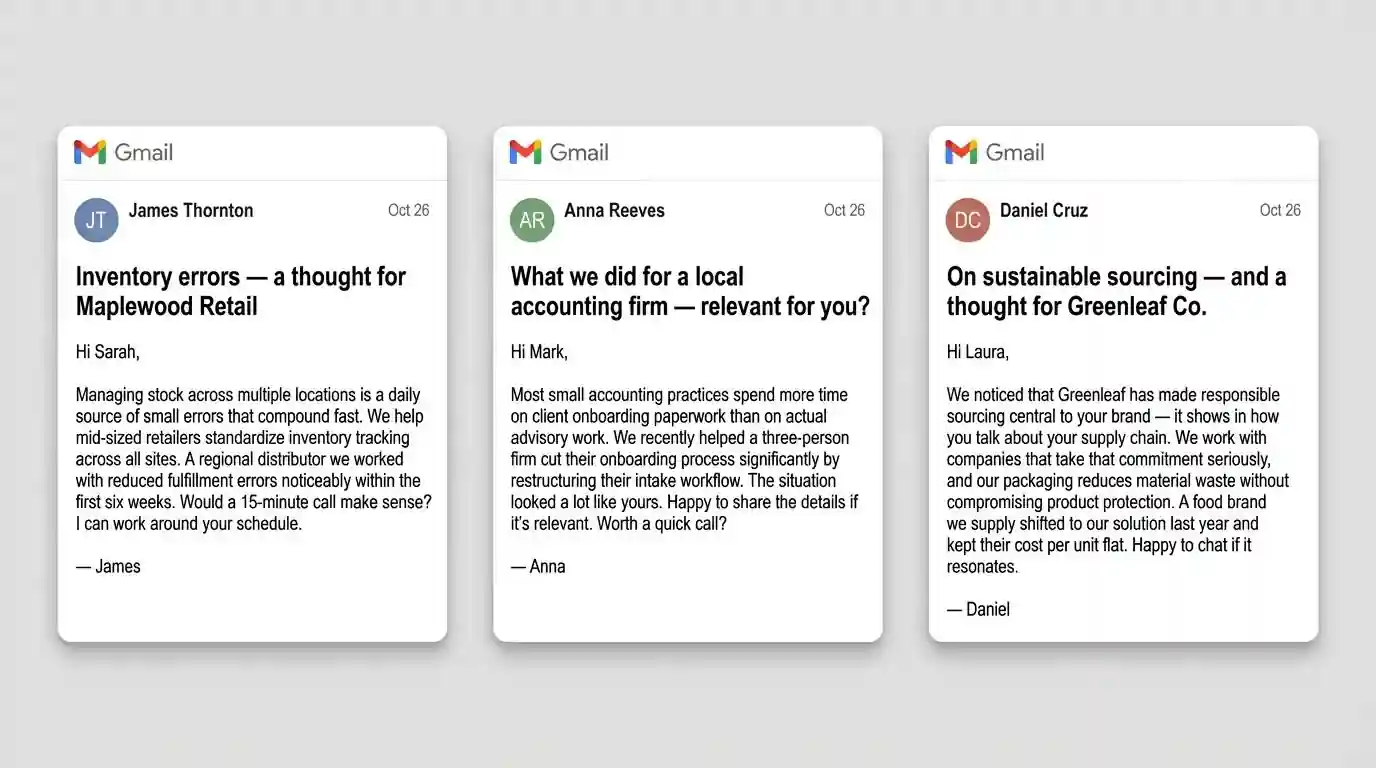
The following structures work as starting points. Each maps directly to a website type — problem-focused, results-focused, and values-focused — and includes the logic behind each section so you can adapt rather than just copy.
Template 1 — For problem-focused websites
Subject: [Specific problem] — a thought for [Company]
Hi [Name],
[One sentence naming the problem, drawn from your site's mission or positioning — written from the prospect's perspective, not yours.]
[One sentence describing what you do, drawn from your USP — specific, not generic.]
[One sentence of proof — a concrete result from a case study or testimonial, adapted to fit the prospect's industry or situation.]
Would a [15-minute call / short demo / quick audit] make sense? I can work around your schedule.
[Your name]
Example in practice: a bookkeeping service whose site leads with "small businesses lose significant time on financial admin" might open with: "For most three-to-five-person businesses, financial admin quietly absorbs more capacity than it should." That's drawn directly from the site's positioning — but reframed for the reader.
Template 2 — For results-focused websites
Subject: What we did for [similar company type] — relevant for you?
Hi [Name],
[One sentence about the prospect's likely situation — based on what your typical client looks like, as described on your site.]
We recently worked with [client type, not name unless public] and [specific result]. The situation was similar to yours in [one specific way].
[One sentence on what made the outcome possible — your process, your USP, your approach.]
Happy to share the details if it's relevant. Worth a quick call?
[Your name]
Template 3 — For values-driven websites
Subject: On [shared value] — and a thought for [Company]
Hi [Name],
[One sentence referencing a value or commitment your site leads with — sustainability, transparency, community focus — framed as something you noticed about their business too.]
We work with companies that take [that value] seriously. [One sentence on your offer, tied directly to how it supports that value.]
[One sentence of proof — ideally from a client with a similar values profile.]
If this resonates, I'd welcome a short conversation.
[Your name]
A note on subject lines: the subject line is the first filter, and it should match the email's actual content. Clickbait subject lines that don't reflect the body damage trust before the first sentence. The templates above use a direct, descriptive format — a specific topic, a specific company. That combination tends to perform better with business audiences than clever or vague alternatives.
How to build a website with Closer and turn its content into cold outreach email scripts
The framework above assumes your website is already doing its job — clear positioning, credible proof, a defined voice. If it isn't, the outreach problem is actually a website problem. Fixing the source fixes everything downstream.
This is where Closer is worth knowing about. It's an AI website builder that generates a complete site from a short brief about your business: original design, copy, logo, and images. The AI drafts the structure, the headlines, and the body copy — all of it oriented toward converting visitors, which means it's also already oriented toward the kind of language that works in cold email from website ideas.
What makes it relevant to outreach specifically is the quality of the output. The copy Closer generates is written with a business's value proposition at the center. That means when you sit down to extract your USP, your problem statement, or your proof points for email scripts, the raw material is already in usable shape — not buried in filler or written in a tone that doesn't match how you actually talk to clients.
The practical sequence for small business website email outreach looks like this:
- build the site and let the AI handle the first pass at copy,
- then apply the framework above to pull the outreach-ready elements — the problem statement, the USP, the voice — directly from pages that are already written to persuade.
When the site is live, repurposing website content for outreach becomes a repeatable process rather than a one-time exercise. When you update a case study or sharpen your positioning on the site, that's the trigger to revisit the relevant email scripts — swap in the new proof point, adjust the problem framing, tighten the USP sentence. It keeps the outreach grounded in whatever your site currently says about you.
Summary
The insight worth keeping:
cold outreach doesn't fail because the channel is broken. It fails because the message has no root. When the website is doing its job — clear problem statement, credible proof, defined voice — it becomes the source for every email script you'll write. The framework here turns that source into a repeatable extraction process: problem statement, proof point, USP, matched CTA, mirrored voice.
The mistake worth avoiding:
writing outreach before the website is ready. Scripts built on vague positioning produce vague emails. If your homepage can't answer "what problem do we solve and for whom" in one sentence, that's the thing to fix first — everything else follows from it.
This approach works best for small businesses that already have some clarity about who they serve and what result they deliver. It's less suited to businesses with a very long sales cycle or highly technical offers where a single email is never going to close the gap. In those cases, the framework still applies, but the CTA needs to be correspondingly modest — not "let's talk about a proposal," but "would a short explainer be useful?"
What to do next:
- If your site has clear positioning and at least one concrete proof point, open Template 1 and draft your first email today — it takes under 20 minutes.
- If the site is thin on specifics, start there: sharpen one page, add one real result, define one differentiator.
- If the site needs to be built from scratch, Closer is a free place to turn your website copy into a cold email template — the AI generates positioning-first copy that's ready to adapt for outreach from day one.


