
How Marketing Video Frameworks Power High-Converting Outreach
Most cold emails share the same fate: they get skimmed for two seconds and closed. The problem is rarely the offer — it's the structure. A message that jumps straight to "we help companies like yours" without any setup feels like a pitch, not a conversation. Video marketers solved this problem years ago. Their content is built on frameworks that guide viewers from indifference to genuine interest, and those same frameworks translate directly into written outreach.
This article breaks down three of them, shows how to map each one onto a real email or LinkedIn message, and explains where your website fits into the equation.
Jump to a Section

Why outreach needs structure
A cold message has roughly one job in the first sentence: make the recipient feel like the message was written for them. Everything after that — the value proposition, the social proof, the ask — only lands if that first impression holds.
The challenge is that most outreach templates are built around the sender's product, not the recipient's situation. They follow a pattern: introduction, feature list, call to action. That sequence works fine in a brochure. In a cold message, it reads as noise.
Structured outreach, borrowed from video marketing, flips that sequence. It starts with the recipient's world, moves through a logical arc, and arrives at an offer that feels earned rather than forced. The result is a message that reads like it came from someone who actually thought about the problem — because the framework requires exactly that.
What video frameworks are and why they work
Video outreach templates aren't just a format — they're a thinking tool. Before you write a single word, the framework forces you to answer: what does this person actually struggle with, and why does it matter to them right now?
Video content operates under ruthless constraints. Viewers drop off in the first few seconds if the opening doesn't connect. Marketers responded by developing frameworks that front-load relevance and delay the pitch until trust is established. The three most widely applied are:
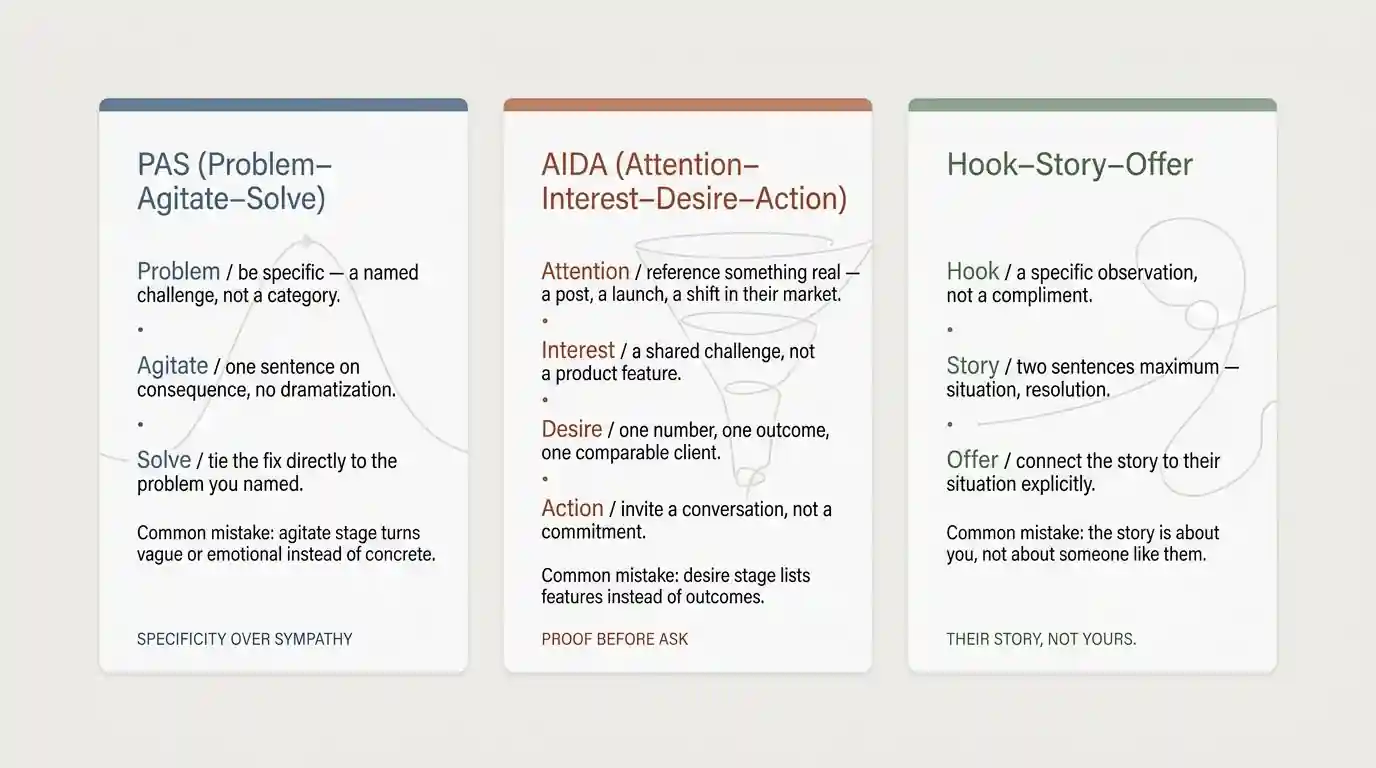
- PAS (Problem–Agitate–Solve),
- AIDA (Attention–Interest–Desire–Action),
- Hook–Story–Offer.
Each one is built on the same underlying logic: earn attention before asking for it. Applied to written outreach, they do something most templates can't — they create a sense of progression. The reader moves through the message rather than scanning it for a reason to stop.
What makes a video-driven outreach strategy practical is that the frameworks are modular. You can adapt the length, adjust the tone, and swap in different proof points without breaking the structure. That flexibility is exactly what B2B outreach requires, where the same framework needs to work across industries, roles, and levels of familiarity.
PAS, AIDA, and Hook–Story–Offer: how each framework maps to outreach
PAS
It’s the most direct of the three. It opens by naming a specific problem the recipient is likely facing, briefly shows what that problem costs them in real terms, then presents a solution. In a two-minute video, each stage gets time to breathe. In a cold email, you're working with three short paragraphs — which actually suits the framework well, since precision matters more than elaboration.
The agitate stage is where most people either get it right or lose the thread. The goal isn't to dramatize — it's to show you understand the downstream consequences. "Delayed proposals slow your pipeline" lands better than "this is a serious issue for your business." Specificity is what separates empathy from generic sympathy.
AIDA
AIDA works differently. It's designed for situations where the recipient isn't actively aware of a problem, or where the relationship is warm enough to lead with curiosity rather than pain.
- The attention hook can be a reference to something the recipient published, a trend in their industry, or a counterintuitive observation.
- The interest stage introduces a shared challenge.
- Desire brings in proof — a specific outcome from a comparable situation.
- Action closes with a low-commitment ask.
Applied to cold email via a marketing video framework, AIDA tends to outperform PAS in LinkedIn outreach, where the context is more conversational and a direct pain-first opener can feel abrupt.
Hook–Story–Offer
Hook–Story–Offer is the slowest burn of the three, and the most memorable when executed well. The hook is a personalized observation — something that signals you've actually looked at their business. The story is a brief, concrete example of someone in a similar position who solved a similar problem. The offer ties that story directly to the recipient's situation.
What sets these templates apart from generic ones is this narrative layer. A story, even two sentences long, activates a different kind of attention than a bullet list of features.
A few elements that consistently improve performance across all three frameworks:
- referencing a specific detail — a recent product launch, a post they wrote, a market shift in their segment — rather than a general industry observation.
- keeping the proof concrete: "reduced onboarding time by a third" outperforms "improved efficiency significantly."
- matching the ask to the stage of the relationship: a first message should invite a conversation, not a commitment.
- treating the subject line as part of the framework, not an afterthought — it's the attention stage before the email is even opened.
|
Framework |
Video function |
Email equivalent |
Best for |
|
PAS |
Opens with a visual pain point, escalates consequences, presents solution |
Names a specific problem, shows its cost in one sentence, offers a concrete fix |
Recipients with a clearly defined operational challenge |
|
AIDA |
Hooks with a surprising fact or bold visual, builds through story and proof |
Subject line tied to something recipient-specific, closes with a low-commitment ask |
Warmer leads or awareness-stage prospects |
|
Hook–Story–Offer |
Leads with an unexpected question, anchors with a customer narrative |
Personalized opener tied to a recent event, two-sentence case study, tailored proposal |
Situations where you have a relevant case study to reference |
Templates
To develop ==sales outreach templates from video frameworks==, you have to understand the framework's logic before you start filling in the blanks. The following templates apply the frameworks directly. Each one is designed to be adapted, not copied — the structure is fixed, the content should reflect your specific prospect.
PAS — B2B email
Subject: Lead flow at [Company] — a quick thought
Hi [Name],
Scaling a sales team tends to surface a specific problem: lead volume grows, but qualification doesn't keep pace, and the pipeline starts filling with noise. [Problem]
That imbalance tends to compress margins quietly — more activity, same close rate, higher cost per acquisition. [Agitate]
We worked with [Similar Company] on exactly this and helped them lift qualified lead share by around 25% over two months by tightening the top-of-funnel criteria. [Solve]
If that's a live challenge at [Company], I'd be glad to walk through how we approached it. Worth a 10-minute call?
[Your Name]
AIDA — LinkedIn message
Hi [Name],
Your post on [Topic] made me think — you're clearly working through something a lot of teams in your space are wrestling with right now. [Attention]
The friction usually shows up at the same point: strong traffic, weak conversion, and messaging that doesn't quite match what the visitor came looking for. [Interest]
We helped a similar business close that gap and saw a 20% conversion lift within the first month. [Desire]
Would it make sense to compare notes for 15 minutes? [Action]
[Your Name]
Hook–Story–Offer — B2B email
Subject: Saw your expansion news — a relevant example
Hi [Name],
I noticed [Company] is expanding into [Market] — that's a move that tends to create a very specific coordination challenge. [Hook]
A client of ours in a comparable position was managing the same thing: new market, stretched team, inconsistent messaging across channels. We restructured their outreach sequence and cut their response time in half. [Story]
Given where [Company] is right now, I think there's a direct parallel. Happy to share the specifics if it's useful. [Offer]
[Your Name]
These are the structural bones. ==B2B video outreach templates== like these only work if the details — the problem named, the company referenced, the proof cited — are real and specific to the recipient.
How to build your outreach presence on Closer
A well-crafted email or LinkedIn message does one thing: it earns a click. What happens after that click is entirely up to your website. If the page the recipient lands on doesn't reinforce the message they just read, the sequence breaks.
Here's how to build that landing presence with Closer.
Step 1. Create your site
In Closer, enter a short description of your business — what you do, who you serve, and what outcome you deliver. The AI generates a complete site in a couple of minutes: original design, copy, headline structure, logo, and images. Nothing about the output is generic; the content is built from your brief, which means the messaging on the page can directly reflect the angle you took in your outreach.
If the first version doesn't land quite right, regenerate any section — as many times as needed. The editor lets you adjust copy, swap design blocks, and restructure the page without touching any code.
Step 2. Align the landing page to your outreach framework
This is where ==video-based cold outreach== and your website start working as a system rather than separate channels. If your email led with a PAS sequence, the landing page should open with the same problem framing. If you referenced a specific outcome in your message, that outcome should appear above the fold — not buried in a features section.
Closer's block library covers the structural elements that matter most for outreach landing pages: social proof sections, outcome-focused headlines, clear call-to-action placements. You can build a page that mirrors the exact arc of your message in under an hour.
Step 3. Go live and start iterating
Once the page is ready, publish it. Every Closer site is fully mobile-responsive, which matters for outreach specifically: a significant portion of recipients open messages on a phone, and the landing experience needs to hold up at that size.
From here, the iteration logic is the same as your messaging: test different headline framings, adjust the proof section, change the CTA copy. The editor makes those changes fast enough that you can run meaningful tests without a development queue.
The principle behind ==video sales outreach best practices== applies equally to your site: structure first, then refine. A page that's live and imperfect beats a page that's perfect and unfinished.

Start here
If your response rate has plateaued, the fix is rarely more volume — it's structure. Pick one framework, PAS is the most straightforward starting point, and rewrite your next three emails with it. Pay attention to the agitate stage; that's where most messages get vague.
The most common mistake is treating the framework as a script rather than a structure. Swapping in your company name without changing the underlying logic produces a message that looks personalized but reads as generic.
Once your messaging is working, make sure your website is built to receive the traffic it generates.
Summary
Video marketing frameworks shift outreach structure from product-first to recipient-first — that single change is what determines whether a message gets a reply.
PAS works best when the recipient has a clearly defined operational problem. AIDA fits situations where the relationship is warmer or the pain point is less obvious. Hook–Story–Offer is the right choice when you have a concrete, relevant case study to anchor the message.
This approach suits B2B teams running targeted outreach to a defined list, where personalization is feasible and each message reflects the recipient's actual situation. It's less suited to high-volume sequences where individual research isn't practical.
The risk this framework closes: sending a message that's technically correct but feels generic. Structure gives you the scaffolding to avoid it — but only if you treat it as a thinking tool, not a fill-in-the-blank template.


