Create a website in 5 minutes
The internet once belonged to those who could code. Launching a website meant hiring developers, learning HTML, or spending weeks wrestling with complicated software. That world has disappeared. Today, creating a website in 5 minutes has shifted from fantasy to standard practice. AI-driven platforms now handle the heavy lifting while you focus on running your business.
This guide walks you through the modern approach to web creation. You'll learn how to go from zero to a fully functional site without touching a single line of code. The best free landing page builders and advanced AI systems have made it possible for anyone to compete online, regardless of technical background.Jump to a Section
The no-code revolution explained
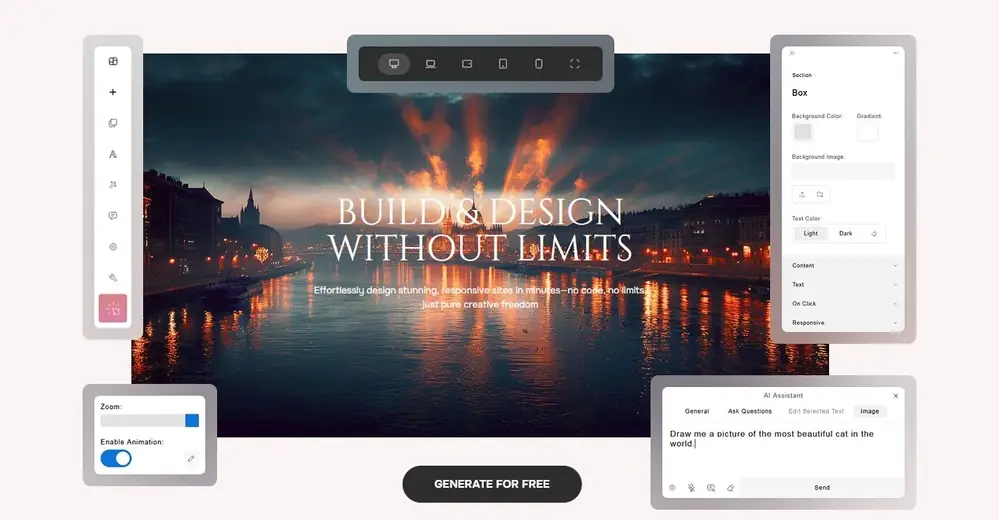
Website builders represent a fundamental shift in how people create online spaces. These platforms let you design, edit, and publish sites through visual interfaces. Some, like Closer AI website builder, do everything for you.
Quick website builders follow the WYSIWYG principle: what you see on screen matches what visitors see when they land on your page. You arrange text blocks, drop in images, adjust colors, and watch changes happen in real time. The technical complexity vanishes, leaving only creative decisions.
The financial impact matters. Traditional development costs thousands of dollars and takes weeks or months. Website builders compress that timeline to hours or even minutes while eliminating most expenses. Small businesses gain access to professional web presence without draining budgets or waiting for developers to finish projects.
The speed advantage extends beyond launch day. When you control your site directly, updates happen instantly. Want to change a price? Swap out a photo? Add a new service? You handle it yourself within minutes. Traditional setups require contacting developers, waiting for availability, paying hourly rates, and dealing with revision cycles that stretch simple changes into multi-day projects.
Three ways to categorize builders
By control method
Website builders differ significantly in how you interact with them:
- Drag-and-drop builders: you assemble sites from pre-made sections by selecting a header design, adding a services block, inserting testimonials, and stacking everything in order. This approach gives you granular control over each element's placement and suits people who enjoy hands-on design work and want to experiment with different arrangements until they find what works.
- Block-based systems: these operate through modular components that you combine like standardized parts — hero sections, feature grids, call-to-action panels. The structure stays consistent, which speeds up creation while maintaining flexibility for customization.
- AI-driven platforms: these generate entire sites from text descriptions. You explain your business in plain language, and the system produces layout, content, and images automatically. The instant website creator approach works well when you want results immediately and prefer strategic decisions over tactical design choices.
By functional purpose
Different builders specialize in different business needs:
- General-purpose builders: these handle any website type and provide tools for blogs, portfolios, business sites, and basic online stores. Flexibility comes at the cost of sometimes lacking specialized features that niche industries require.
- E-commerce platforms: these prioritize product management, inventory tracking, payment processing, and checkout optimization. They excel at selling physical or digital products but often lack robust content publishing tools for blogs or resource centers.
- Landing page builders: these focus exclusively on conversion-optimized single-page sites and emphasize above-the-fold content, clear calls to action, and lead capture forms. Marketing campaigns and product launches benefit from these specialized tools, though they don't support multi-page site structures well.
- Blogging platforms: these optimize for content creation and reader engagement, handling article formatting, category organization, comment systems, and RSS feeds efficiently. Publishers and content creators get powerful editorial tools but limited e-commerce or service business features.
By customization level
The degree of design freedom varies widely across platforms:
- Template-based builders: these offer pre-designed layouts you populate with your content. You pick a style, swap in text and images, adjust colors, and publish. Speed defines this category — you launch quickly with polished results. The tradeoff: your site might resemble others using the same template.
- Open canvas systems: these provide unlimited design freedom where you position any element anywhere, adjust spacing down to the pixel, and build a website without coding while maintaining complete creative control. Designers and agencies favor these platforms when implementing precise visual concepts or brand guidelines.
- Hybrid platforms: these combine both approaches by starting with structured templates or AI-generated designs but unlocking full customization afterward. You get quick initial results, then refine details as needed. This model suits businesses that want professional starting points with room for personalization.

How Closer handles instant creation
Closer combines AI generation with professional design capabilities in a single ecosystem. The platform functions as designer, copywriter, and brand strategist rolled into one system.
When you input details about your business, the AI doesn't pull from a template library. It generates custom layouts specific to your industry and goals. Each site structure differs from the next, avoiding the cookie-cutter problem that plagues template systems.
The generation process analyzes competitive landscapes and industry best practices. If you're launching a fitness coaching business, the AI understands what converts in that space — transformation stories, credential displays, clear program breakdowns, and prominent booking buttons. It structures your site to match proven patterns while maintaining visual uniqueness.
The content generation goes beyond filling placeholder text. The AI crafts headlines designed to convert, writes body copy that speaks to your target audience, and develops messaging that aligns with your brand voice. This eliminates the blank page problem that stops many people from launching sites.
Visual branding happens automatically. The system creates logos tailored to your business style and selects high-quality images that match your industry. You get a cohesive visual identity without hiring designers or photographers. The color schemes reflect psychological principles — trust-building blues for financial services, energetic oranges for fitness brands, sophisticated neutrals for professional services.
Building your site on Closer step by step
Start by telling the AI about your business. Describe what you sell, who you serve, and what makes you different. The more specific you get, the better the output matches your vision.
The generation happens in seconds. The platform analyzes your input, structures the site logically, and populates it with appropriate content. You see a complete website appear — navigation, sections, calls to action, everything you need to start collecting leads or selling products.
Don't like a particular section? Regenerate it. The system produces unlimited variations until you find something that clicks. This iterative approach lets you refine without starting over. Each regeneration applies different design principles, layout structures, and content angles, giving you genuine variety rather than superficial tweaks.
Final adjustments happen through a simple editor. Change text, swap images, adjust colors — all through point-and-click actions. Technical knowledge stays irrelevant; if you can edit a document, you can modify your site.
Professional features at your fingertips
The design library contains thousands of pre-built blocks covering every common business need:
- testimonial sections with various layouts;
- pricing tables that highlight your offers;
- team profiles that build credibility;
- FAQ sections that answer visitor questions;
- contact forms that capture leads.
Canvas mode unlocks advanced design capabilities. A fast website builder doesn't have to mean limited options — professionals gain access to tools that let them construct custom layouts from scratch, positioning elements with precision.
SEO tools optimize your site for search engines from day one. Meta descriptions, page titles, and URL structures get configured automatically based on best practices. Your site becomes discoverable without needing SEO expertise. The system also generates semantic HTML that search engines parse efficiently, improving your chances of ranking for relevant queries.
Mobile responsiveness happens automatically. The platform ensures your site adapts to every screen size without manual configuration. Visitors on phones, tablets, and desktops all see properly formatted pages. Touch targets expand on mobile devices, navigation menus collapse intelligently, and images scale appropriately — all without you writing a single media query.
Why AI generation wins
Traditional methods force you to make hundreds of small decisions. Which template? What colors? Where does this button go? How should this headline read? Decision fatigue sets in before you finish the homepage.
AI-powered creation flips this model. You make a website fast by handling only the strategic decisions — what you sell, who you serve, what matters to your audience. The system handles tactical execution based on proven design and marketing principles.
Speed matters in competitive markets. Every day without a website represents lost opportunities. When you can launch in minutes, you start capturing leads and generating revenue immediately. Early market entry compounds advantages, letting you establish presence while competitors remain invisible.
On Closer, quality remains high despite the speed. The AI applies professional standards to layout, typography, color theory, and user experience. Sites built this way match or exceed what small businesses typically get from agencies, but without the five-figure price tag and months-long timeline.
Uniqueness solves a major problem with template-based systems. Your site doesn't look like fifty others in your industry. The design, content, images, and branding are generated specifically for your business. Visitors perceive you as established and professional rather than generic.
The cost advantage compounds over time. Traditional sites require ongoing developer involvement for updates and changes. With best free landing page builders and AI platforms, you maintain complete control without recurring technical costs. Budget previously allocated to maintenance gets redirected toward marketing, inventory, or growth initiatives that actually drive revenue.