Build a website without coding
Starting a business online has never been more accessible. Gone are the days when launching a website meant hiring developers or spending months learning HTML. Today, you can build a website without coding through intuitive platforms that handle the technical complexity for you. The question isn't whether you can create a professional web presence anymore. The question is which approach fits your specific needs and timeline.
Jump to a Section
The paths to building without code
Several distinct methods exist for creating websites without programming knowledge. Each offers different levels of control, speed, and customization. Understanding these approaches helps you select the right tool for your situation rather than defaulting to whatever appears first in search results.
Classic visual builders (drag-and-drop)
These represent the most established option. Visual builders operate on the "What You See Is What You Get" (WYSIWYG) principle. You select elements like images, buttons, or text blocks and position them directly on your page. The interface shows exactly how your site will appear to visitors as you build it.
This approach gives you granular control over placement and design. You decide precisely where every component sits, how large it appears, and what happens when someone clicks it. However, it requires patience and an eye for layout. You'll spend time adjusting spacing, aligning elements, and ensuring everything looks cohesive across different screen sizes.
The learning curve varies depending on the platform. Some visual builders offer simplified interfaces with limited options, making them easier to grasp but less flexible. Others provide extensive customization capabilities that rival professional design software, though mastering these features takes longer. The trade-off between power and simplicity defines your experience with drag-and-drop tools.
Template-based solutions
Templates work well when you want to skip the design phase entirely. You browse pre-made layouts organized by industry or purpose. A restaurant template comes with menus, reservation forms, and photo galleries already configured. A consulting template includes testimonial sections, service descriptions, and contact forms.
After selecting your template, you replace placeholder content with your own text and images. The design framework stays intact, which means less flexibility but also less room for mistakes. Your site goes live faster because the heavy lifting happened before you arrived.
The quality of templates varies dramatically across platforms. Premium options often feature sophisticated layouts created by professional designers, with careful attention to typography, color harmony, and user flow. Budget templates may look dated or generic. Evaluating template quality before committing to a platform saves frustration later. Look for modern aesthetics, clear navigation structures, and examples of sites built with those templates.
Section-based construction
Rather than manipulating individual elements pixel by pixel, section-based builders let you stack pre-designed blocks. Think of it like assembling with LEGO pieces. You add a hero section at the top, drop in an "About Us" block below that, then insert a contact form at the bottom.
This method strikes a balance between speed and customization. The sections already contain proper spacing, typography, and responsive behavior. You focus on content and overall structure rather than technical details. Mobile responsiveness happens automatically because each section adapts to different screen widths.
Section libraries typically organize blocks by function: hero sections, feature grids, testimonial carousels, pricing tables, and contact forms. Within each category, you'll find multiple style variations. A hero section might come in ten different layouts, from minimalist text-over-image designs to complex multi-column arrangements. This variety allows personality without requiring design skills.
The real advantage emerges when combining sections. A strong section-based builder ensures that any block pairs well with any other block. Colors, fonts, and spacing remain consistent even when mixing sections from different style families. This consistency proves difficult to achieve in pure drag-and-drop environments where every element requires manual styling.
AI-driven generation
The newest category flips the entire process. Instead of building anything yourself, you describe what you need. The AI interprets your requirements and generates the complete site. Copy, design, images, and layout all appear based on your description.
This represents a fundamental shift. You're no longer constructing. You're communicating your vision, and the technology handles execution. The barrier between idea and implementation nearly disappears.
Early AI website generators produced generic results because they relied on simple template substitution. Modern systems employ sophisticated language models that understand context, industry conventions, and persuasive writing principles. They analyze your input for industry clues, target audience indicators, and tone preferences, then generate content that reflects those insights.
Introducing Closer: the next evolution of AI web building
The Closer AI Website Builder demonstrates where website creation technology is heading. Rather than simply automating templates, it acts as a comprehensive digital partner that understands business goals and translates them into effective web experiences.
AI that does the heavy lifting
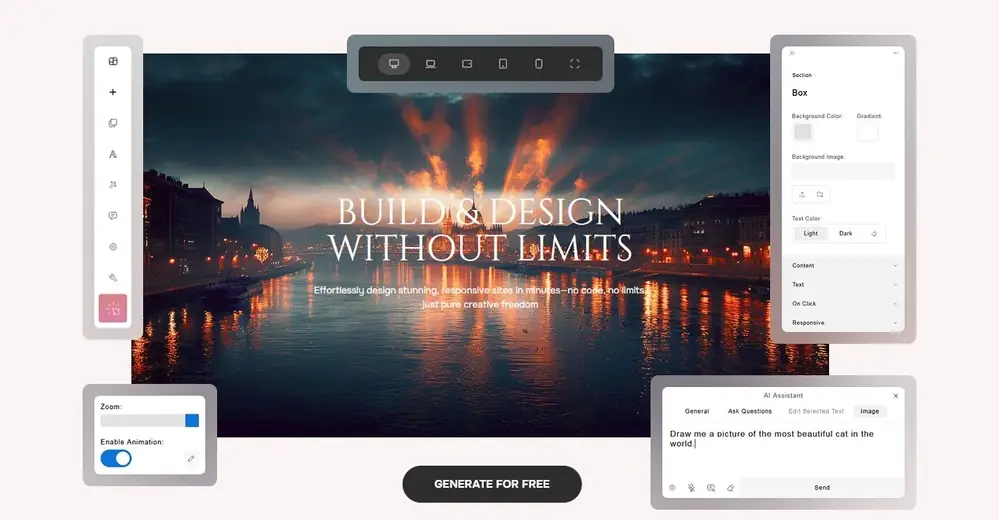
When you start with Closer, you don't face a blank canvas waiting to be filled. The platform generates unique designs tailored to your specific business rather than recycling generic templates. The AI writes headlines and body copy designed to convert visitors into customers. It creates logos and selects imagery that matches your brand's personality.
The system combines multiple specialized AI models. One handles visual design, another focuses on persuasive copywriting, and a third manages branding elements. They work together to produce cohesive results that feel intentionally designed rather than algorithmically assembled.
The copywriting component deserves particular attention. Generic website builders without programming might fill your site with placeholder text that you need to rewrite completely. Closer generates industry-specific copy that addresses common customer questions, highlights relevant benefits, and incorporates persuasive frameworks. A law firm receives content emphasizing trust and expertise. An e-commerce store gets product descriptions optimized for conversion. The AI adapts its writing style to match your sector.
Unlimited creative freedom
Many AI tools share a common frustration: you get one output and either accept it or start over. Closer eliminates this limitation by allowing unlimited regeneration of any element or the entire site. If the first logo doesn't resonate, regenerate just that component. If the homepage feels off, recreate it.
For those who want hands-on refinement, an intuitive editor allows quick adjustments to any generated element. Change colors, swap images, or rewrite sections without touching code. For designers seeking complete control, canvas mode provides a blank workspace with zero restrictions. You can create a website without code while maintaining the precision of traditional development tools.
This flexibility addresses a critical weakness in other AI platforms: the inability to refine outputs. When an AI-generated headline is almost perfect but needs tweaking, you shouldn't have to regenerate the entire page or accept mediocrity. Closer lets you edit at whatever level makes sense — regenerate the whole site, regenerate a section, regenerate a single element, or manually edit specific words.
Key features at a glance
The platform includes several components worth noting:
- A massive library of pre-designed blocks and visual effects ready to drop into your pages;
- Built-in SEO tools that optimize your site for search engines without requiring technical knowledge;
- Automatic mobile responsiveness that ensures perfect display across all devices;
- Rapid deployment that lets you go from concept to live site in minutes rather;
- Integration capabilities that connect your site to analytics platforms, online widgets like live chats, and payment processors (coming soon).
These features integrate seamlessly. SEO optimization happens during content generation, not as an afterthought. Mobile layouts adjust as you build, not after you've finished. The blocks library expands your options without overwhelming you with choices.
The SEO component operates differently from traditional tools. Rather than asking you to manually add meta descriptions and alt tags, the AI generates these elements automatically based on your content. It ensures proper heading hierarchy, creates descriptive URLs, and structures data in ways search engines prefer. For business owners unfamiliar with technical SEO, this automation removes a significant obstacle.
Why choose the AI path?
The primary advantage of AI-driven website building is the elimination of "blank page syndrome." That moment when you sit down to create something and have no idea where to begin simply doesn't exist. You describe your business, and the platform produces a starting point immediately.
This approach delivers several concrete benefits. You create a website in 5 minutes instead of spending weeks learning new software or design principles. The cost stays manageable because you don't need separate professionals for design, copywriting, and development. The learning curve flattens dramatically — if you can articulate what your business does, you can build a professional web presence.
Perhaps most valuable is the iterative nature. Your first version doesn't need to be perfect. As your business evolves, you regenerate sections, refine messaging, or completely reimagine your design. The platform grows with you rather than locking you into initial decisions.
Speed matters more than most people realize. The faster you launch, the sooner you start gathering real feedback from actual visitors. You discover which messages resonate, which offers convert, and which pages need improvement. This real-world data proves infinitely more valuable than hypothetical planning. AI-powered builders compress the time between conception and validation from months to minutes.
The accessibility factor extends beyond technical skills. People who speak English as a second language, who lack design training, or who simply feel intimidated by technology can now participate in the digital economy. The AI compensates for skill gaps without requiring extensive training. This democratization opens opportunities for entrepreneurs in regions with limited access to web development services.
Building is now a creative challenge
The technical barriers to launching a website have essentially vanished. Platforms like Closer no code website builder have reduced the gap between vision and execution to the time it takes to describe what you want. You don't need to understand servers, hosting, or responsive design principles. The infrastructure that once required specialized knowledge now operates invisibly in the background.
What remains is the creative work: articulating your value proposition, understanding your audience, and crafting messages that resonate. These challenges can't be automated away. But now you can focus entirely on them instead of struggling with technical implementation. The shift from "how to create a business website for free" to "what should I communicate" represents progress for entrepreneurs everywhere.
Consider what this means for testing business ideas. You can launch a landing page for a new product concept this afternoon. If it gains traction, expand it into a full site. If it doesn't resonate, try a different approach tomorrow. The low cost and high speed of no coding website makers transform website creation from a major investment into an ongoing conversation with your market.
The barrier to entry has dropped so low that the only thing standing between you and a professional online presence is the few minutes required to communicate your vision to the AI. For entrepreneurs and business owners ready to establish their digital footprint, this represents a significant shift. You can build a website without coding and launch your online business today rather than someday. The technology handles complexity. You provide the vision.