Create customer support videos from scripts with AI video builders
Jump to a Section
What is an AI video script generator
An AI video script generator is a tool that takes written source material — raw support notes, customer questions, agent responses — and transforms it into a structured video script, then into a finished video. The AI reads your content, identifies the logical flow, and writes a script with scenes, pacing, and visual cues. Voiceover, on-screen text, and animations follow automatically.
For customer support teams, this is practical precisely because the raw material already exists: ticket threads, FAQ documents, chat transcripts. The generator's job is to turn that unstructured content into something a viewer can follow without effort. A script to video generator works from language, not from footage — the bottleneck shifts from "do we have the resources to make this?" to "do we have clear source material?"
From script to video: how it works on your website
You feed the platform your support content — customer questions with agent answers, a troubleshooting guide, an onboarding checklist. The AI produces a structured script, then a video file ready for embedding. Create video from script AI tools also support iteration: if a step needs updating after a product change, you revise the source content and regenerate. No reshooting, no re-editing.
The resulting videos are built for web delivery. They load quickly, display cleanly on mobile, and drop into any page — a product page, a help center article, a checkout FAQ — without custom development work.
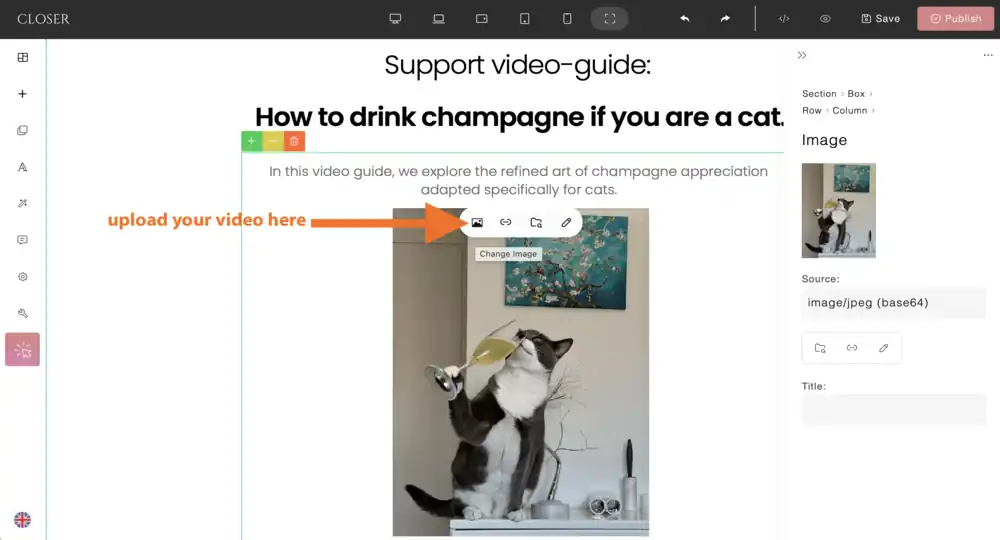
How to add support videos to a website is simpler than it sounds. Most AI video platforms generate an embed code alongside the video file. Paste that code into the relevant page section in your website editor, and the video appears inline.
What makes good source material for a support video
The quality of the output depends on the quality of the input. A few principles help the AI produce a usable script:
- provide real customer language: actual questions from tickets or chat logs give the AI the framing that viewers recognize. "Why isn't my order showing up?" works better than "order tracking inquiry."
- pair each question with a complete answer: the AI needs both sides of the exchange to build a script with a clear resolution.
- keep each input focused on one topic: bundling several unrelated issues into a single document produces an unfocused script. One question, one answer, one video.
- flag the critical step: if one action in a process is where most customers get confused, note that in the source material. The AI will weight it accordingly.
Support content written this way produces a video that feels guided rather than narrated — the difference between a colleague walking you through something and a recorded lecture.
Customer support video use cases
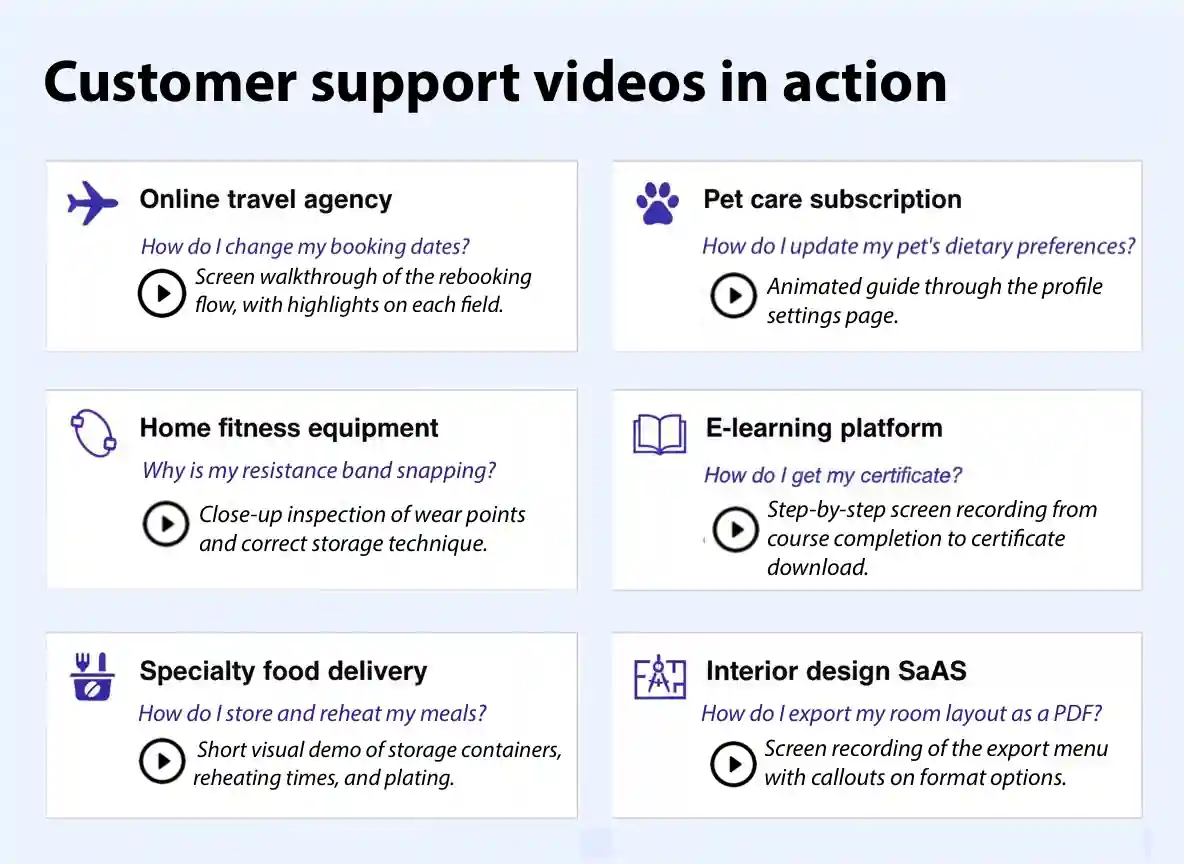
Customer support video examples look different depending on the industry, but the underlying logic stays the same: replace a written explanation with a visual one wherever the process involves multiple steps or a physical action.
- A home goods retailer might feed a set of assembly-related support tickets into the platform and produce a video answering "how do I put this together?" — showing the parts laid out, the order of assembly, and where the connectors fit.
- A subscription box service could take its most common cancellation and pause queries and turn them into a 60-second screen walkthrough.
- A wellness app might convert its onboarding FAQ into an animated interface guide explaining how to set up a daily reminder schedule.
AI customer support videos are also well suited to proactive onboarding. When a new client signs up for a bookkeeping service, a video explaining how to upload documents, where to find reports, and how to message their accountant removes the need for an introductory call. The client gets oriented at their own pace; the support team handles fewer repeat questions.
Troubleshooting is another strong use case. A kitchen equipment brand can take its most frequent complaint threads and produce a video showing how to check the seal, clean the element, and test the temperature setting — turning a potential complaint into a resolved issue before it reaches the inbox.
Where to place support videos on your website
Placement matters as much as content. A video buried three clicks deep in a help center will reach far fewer viewers than one embedded directly on the relevant page. Some locations consistently outperform others:
- product pages: a short video answering the most common pre-purchase question, placed near the product description, addresses hesitation at exactly the right moment.
- checkout and cart pages: video FAQ for website content addressing shipping, returns, and payment options reduces last-minute uncertainty.
- onboarding flows: a video embedded in the welcome email or the first login screen helps new users orient themselves without contacting support.
- dedicated help center: a structured library of AI videos for business website support, organized by topic, gives returning customers a self-service resource they'll actually consult.
The general principle: place the video where the question arises, not where the answer lives.
How to build a website with customer support videos on Closer
Support content works best as a system, not a single format. Video answers the "show me how" questions well, but a complete support experience also needs text manuals for those who prefer to read and search at their own pace, a search function that surfaces the right answer without browsing, and a direct line to a live agent for situations that no FAQ can resolve. Different visitors absorb information differently — some will watch a two-minute walkthrough, others will scan a written guide, and a few will want to type their question to a person. A well-built support site accommodates all three.
Closer is an AI website builder that handles the structural side of this. It generates a complete website from a business description: design, layout, copy, logo, and images, all produced by AI. For support-focused pages, Closer's library of pre-built sections includes article layouts, FAQ blocks, and content sections sized for embedded video. Adding website customer support content is easy — video embeds alongside text guides and contact options. The site is mobile-responsive from the start, so every format displays correctly on any device without additional configuration.
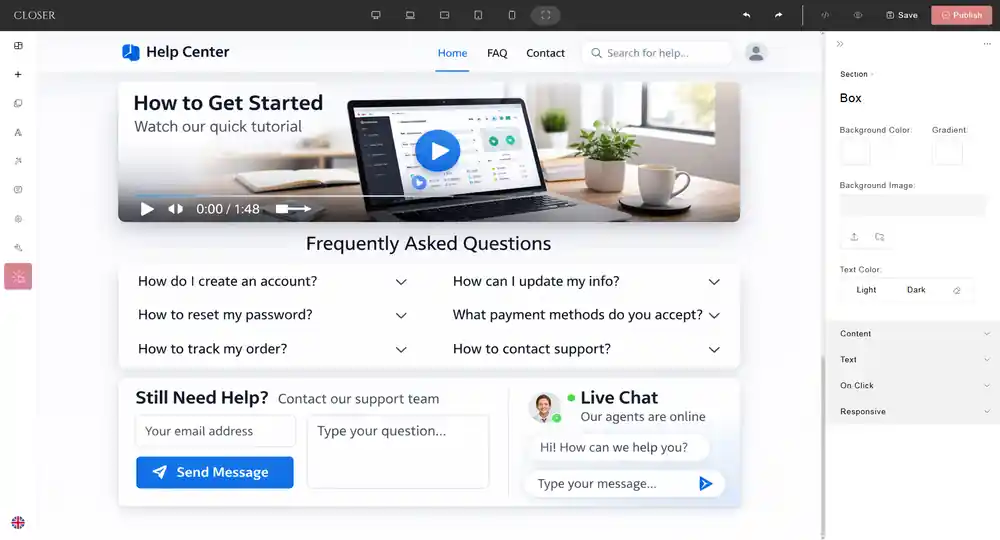
Customer service videos made with AI fit naturally into Closer's page structure. A help page can hold an embedded onboarding video at the top, a text FAQ below it, and a contact form or live chat widget at the bottom — giving visitors a layered self-service experience without forcing them into a single format.
For teams that want full design control, Closer includes a canvas mode for building from scratch. For everyone else, the AI handles the structure, and the editor handles the adjustments.
Summary
Support content works best when it meets visitors at the point of confusion — not after they've searched, scrolled, and given up. Video gets closer to that goal than text because it shows rather than tells. Video script AI customer service tools have made video production accessible to teams without production budgets, and Closer website builder has made it straightforward to put that content in front of the right audience.
The workflow is genuinely simple:
- gather support content,
- generate a script,
- produce a video,
- embed it on your site.
What takes time is deciding which questions deserve a video first. Start with the question your support team answers most often. Build the page around the answer. The rest follows naturally.
Closer lets you launch a professional website in minutes, with AI-generated content and a built-in structure ready for support video embeds.